These studies provide further evidence that decreased expression of TIEG1 results in suppression of Runx2 and implicate TIEG1 as a novel regulator of Runx2 in osteoblasts. Furthermore, these studies provide evidence that decreased TIEG1 levels are also associated with decreased expression of other osteoblast-related genes, either as a result of direct regulation by TIEG1 or due to decreased expression of Runx2. This study demonstrates that suppression of TIEG1 results in decreased expression of Runx2 while over-expression of TIEG1 up-regulates Runx2 levels. Runx2 promoter luciferase reporter constructs and ChIP analyses have revealed that TIEG1’s regulation of Runx2 expression occurs in a DNA binding dependent manner through regulatory elements located in the proximal region of the P1 promoter. We have also provided evidence that TIEG1 plays a role in mediating 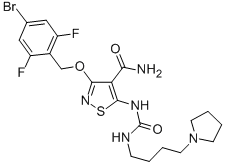 the responsiveness and magnitude of Runx2 expression following TGFb1 and BMP2 treatment and have implicated the ubiquitin/proteasome Mepiroxol pathway as another mechanism to precisely control Runx2 levels by targeting TIEG1 for degradation. Furthermore, we have shown that TIEG1 can interact with the Runx2 protein and serve as a coactivator for Runx2 transcriptional activity. Finally, osteoblast differentiation studies have demonstrated that restoration of Runx2 expression in TIEG1 KO cells partially rescues their mineralization defect implicating a role for this signaling pathway in mediating the osteopenic phenotype of TIEG1 KO mice. Therefore, a model has evolved whereby TIEG1 serves as an important mediator of both Runx2 expression levels and Runx2 transcriptional activity in osteoblasts. The importance of Runx2 with regard to skeletal development and osteoblast differentiation has been well described. Runx2 plays a critical role as a lineage determining Albaspidin-AA transcription factor which is expressed in mesenchymal precursor cells and functions to direct their differentiation into osteoblasts. Runx2 is also considered a master regulator of osteoblast differentiation as it induces the expression of osterix, another transcription factor whose expression is essential for terminal osteoblast differentiation and mineralization. In addition to osterix, Runx2 regulates many other osteoblast related genes. Deletion of Runx2 in mice causes arrest of osteoblast differentiation and results in neonates with a completely cartilaginous skeleton which die shortly after birth. Furthermore, germline mutations in the Runx2 gene are strongly associated with patients diagnosed with cleidocranial dysplasia, an autosomal dominant skeletal disorder. The precise regulation of Runx2 expression and activity is essential for normal bone formation as mice over-expressing Runx2 under the control of the collagen 1a1 2.3-kb promoter exhibit an osteopenic phenotype. Indeed, Runx2 has been shown to be regulated at the level of transcriptional control, protein activity and protein turnover. However, the specific factors and their associated signaling pathways involved in these processes continue to be elucidated. At the level of transcriptional control, a small number of transcription factors have been indentified which directly regulate Runx2 expression levels. Positive regulators of Runx2 expression in osteoblasts include the homeobox genes, Msx2 and Bapx1, as well as RBP1, SP1 and ELK1. In contrast, Hoax2 and Sox8 have been shown to inhibit Runx2 expression. In the present study, TIEG1 is shown to act as a positive regulator of Runx2 expression in osteoblasts implying an additional role for this transcription factor in regulating osteoblastogenesis and bone development through the actions of Runx2. At the level of Runx2 function, many proteins have been identified that interact with this important transcription factor to modulate its activity. Proteins such as Stat1, Sox9, Aj18, MEF, Nrf2, YAP, HDAC4, and p53 have all been shown to interact with the Runx2 protein to inhibit its transcriptional activity.