Therefore LDL cholesterol seems not able to predict the Homatropine Bromide outcome of endovascular intervention. This is probably due to the fact that rigorous LDL cholesterol control with statins is installed in patients suffering from PAD. Further, the independence of LDL cholesterol levels and sdLDL 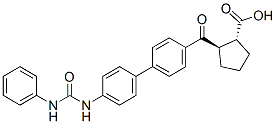 particles is underlined by studies describing different effects of certain therapies on LDL cholesterol and sdLDL. The GGE method for determination of LDL particle size and classification has been shown to be reliable, with a high agreement when compared to other methods. However, it should be mentioned that there are also other methods as nuclear magnetic resonance or ion mobility with comparable precision. Further, newer methods have been developed that are convenient to use and may help to establish the use of LDL particle size outside the academic research The strength of this study is that the data were prospectively assessed in a well-defined cohort of patients with PAD undergoing revascularization. Further, due to the single center design of the study, it was possible that all clinical and biochemical measurements were performed at the same place and by the same investigators, therefore limiting possible inter-observer biases. This was of particular importance with respect to the measurement of LDL size and assessment of restenosis rate. A limitation is the relatively small sample size. In summary, the presence of high amounts of small dense LDL particles is a negative predictor regarding successful outcome of Benzethonium Chloride peripheral angioplasty. Therefore, measurement of this parameter should be considered in patients undergoing balloon angioplasty. Further, therapies targeting LDL particle size and the proportion of sdLDL particles might be considered in patients with high amounts of sdLDL particles in the future to improve clinical outcome after vascular intervention. Strategies with a single time-point for testing were assumed to require up to two physician visits, with the second visit being needed only for those who required treatment because of positive testing. Strategies involving retesting were assumed to require up to three physician visits. Non-medical and indirect costs were not included, in keeping with other comparable modelling papers. The parameters tested were cost of managing one cancer, cost of a physician visit, cost of medication for eradication, cost of managing one peptic ulcer and lifetime risk of gastric cancer. The change in net cost per cancer saved was estimated against the proportional change in each of the five parameters. A probabilistic model was developed in which the model parameters were drawn from their full uncertainty distributions, as given in Table 1. The distributions were assumed to be normal with the mean equal to the best estimate and upper and lower range equal to the 95% area under the curve of the normal distribution. For each of 10,000 iterations, a parameter was drawn from each uncertainty distribution and results calculated; including costs, number of cancers averted, number of ulcers averted false negatives and positive results. Sensitivity to change in parameters was estimated using multivariable regression, with cost per cancer saved as the continuous outcome variable and the parameters above as the predictor variables. Linear relationships were assumed and the parameters were not transformed. Figures represent the effect on cost per cancer prevented if each parameter was increased by 1% of the original estimate used.